Builds a graph of the rules of your fictional world — what's possible, who knows what, what objects exist — and flags places where two rules contradict each other.
What it measures
The analyzer walks your manuscript and extracts declarative rules — statements the text asserts as facts about how the world works. Rules can be about physics ("magic requires blood"), technology ("cars don't exist in this era"), social structure ("only the eldest inherits"), biology ("dragons breathe fire"), or specific entities ("the queen has no siblings"). Each rule becomes a logic node in a directed graph.
Once the graph is built, the analyzer scans for contradiction cycles — pairs (or longer chains) of rules that cannot all be true at once. A cycle can be direct ("magic requires blood" in Chapter 3 vs. "magic is drawn from willpower alone" in Chapter 12), transitive ("A implies B" + "B implies C" + "C implies not-A"), or scope-conflicting (a rule stated as universal that a later scene silently exempts a character from).
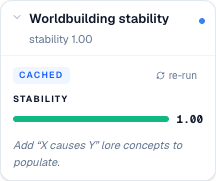
The stability index is a 0–1 score summarising the graph's health. 1.0 means every rule is internally consistent with every other rule the analyzer could compare. Below 0.66 the analyzer flags the graph as amber (some inconsistency); below 0.33 it flags red (structural incoherence). The score is a summary — the real value is in the specific contradiction cycles listed below it.
A caveat: the analyzer is only as good as its ability to parse declarative statements from prose. Rules stated in dialogue by unreliable narrators, implied rules the text never says out loud, and rules a character believes but the text does not endorse can all confuse the extraction. Treat the flag as a prompt to re-read those two passages, not as automatic proof of a contradiction.
Why it's useful
For any manuscript with invented rules — fantasy, science fiction, alt-history, near-future speculative, cosmic horror — the internal consistency of the world is what earns and keeps the reader's trust. One "the magic requires blood" chapter followed six chapters later by an "the magic is just willpower" chapter breaks the pact. The reader stops treating the world as a real place with real physics, starts treating it as a set of authorial conveniences, and disengages from the stakes because nothing costs anything if the rules are negotiable.
The problem is that you, the writer, cannot see this. You wrote both rules; you know what you meant; your brain retconciles them silently. Beta readers catch some of these, but only the ones close enough together to hold in working memory — the ones twelve chapters apart slip past everyone including your editor. This report catches the drift.
It's the natural companion to your Lore Book, which is where you should be declaring the canonical rules of your world before you write. Worldbuilding stability catches the places where your prose has silently drifted from what you declared. Between the two, "did the character's magic system change on page 340?" stops being a question you have to hold in your own head.
How to read it
At the top of the expanded card is the Stability row — a horizontal bar with the numeric stability index on the right (mono, tabular). The bar is green when stability is above 0.66, amber between 0.33 and 0.66, red below 0.33. The collapsed card headline reads stability … so you can see the number without expanding.
Below the stability bar is the Logic nodes section — a wrap-flow of small cyan chips, one per rule the analyzer extracted from your prose. This is your world's ruleset as the analyzer sees it. Skim it. If a chip surprises you ("wait, I never said that"), the extraction over-inferred and the report may be flagging false-positive contradictions built on that node. If a rule you did intend to establish isn't in the list, the analyzer missed it — usually because it was stated only in dialogue, or only implied.
Below the logic nodes, when contradictions exist, is the Contradiction cycles section — a red-tinted list where each row shows the cycle as an arrow chain (Rule A → Rule B → Rule C) with a red left-border for emphasis. This is your actionable list. Each row is a specific pair (or chain) of statements the analyzer thinks cannot all be true — go find those passages in your manuscript, re-read them side by side, and decide whether to reconcile, retcon, or explicitly explain the exception.
There's no click-through-to-jump in this card — it's a diagnostic, not a navigation surface. Use the rule text in each cycle to search your manuscript directly (⌘F in the editor).
When to ignore it
Contemporary realism has no invented rules to check against — the analyzer will find a small logic graph and report a stability score near 1.0 with an empty contradiction list. That's expected; there's nothing to flag when the world is just the world. Non-fiction, memoir, and journalism will look the same.
Second: some contradictions are intentional. Unreliable narrators contradict themselves; magical-realist prose deliberately makes physics ambiguous; time-travel narratives require the reader to hold contradictions in mind on purpose. If your story requires the world to be internally paradoxical, this report will keep flagging what you meant. That's fine — you can ignore it, but sanity-check whether the contradiction is one you intended vs. one that snuck in.
Third: character beliefs often contradict world facts. A character convinced dragons don't exist while a dragon appears in Chapter 20 is not a contradiction — it's the setup for the reveal. The analyzer sometimes flags these as contradictions when it should not. Trust the flag as a prompt to re-read, not as an accusation.
Finally, works-in-progress inherit worldbuilding drift from every draft. If you've been revising for years and half your rules are legacy from Draft 1 that you've since replaced, expect a low stability score until you finish the pass. Run this report after you're done editing, not during.
How to run it
- Click Write in the left sidebar and open the document you want to analyze.
- Open the right rail: click the Reports button (bar-chart icon) in the editor's top toolbar.
- In the rail header, click the Reports tab.
- Scroll to the Worldbuilding stability card under the "Narratology" heading.
- Click the card to expand. First-time runs take 5–20 seconds (spinner in the header while streaming). Cached runs render instantly.
- The card headline shows a stability index (
stability …); the expanded body lists the contradiction pairs and lets you click through to the offending paragraphs.
What to read next
- Plot holes — the sister report for real-world continuity
- Lore Book — where the canonical rules of your world live
- Reports — back to the panel overview