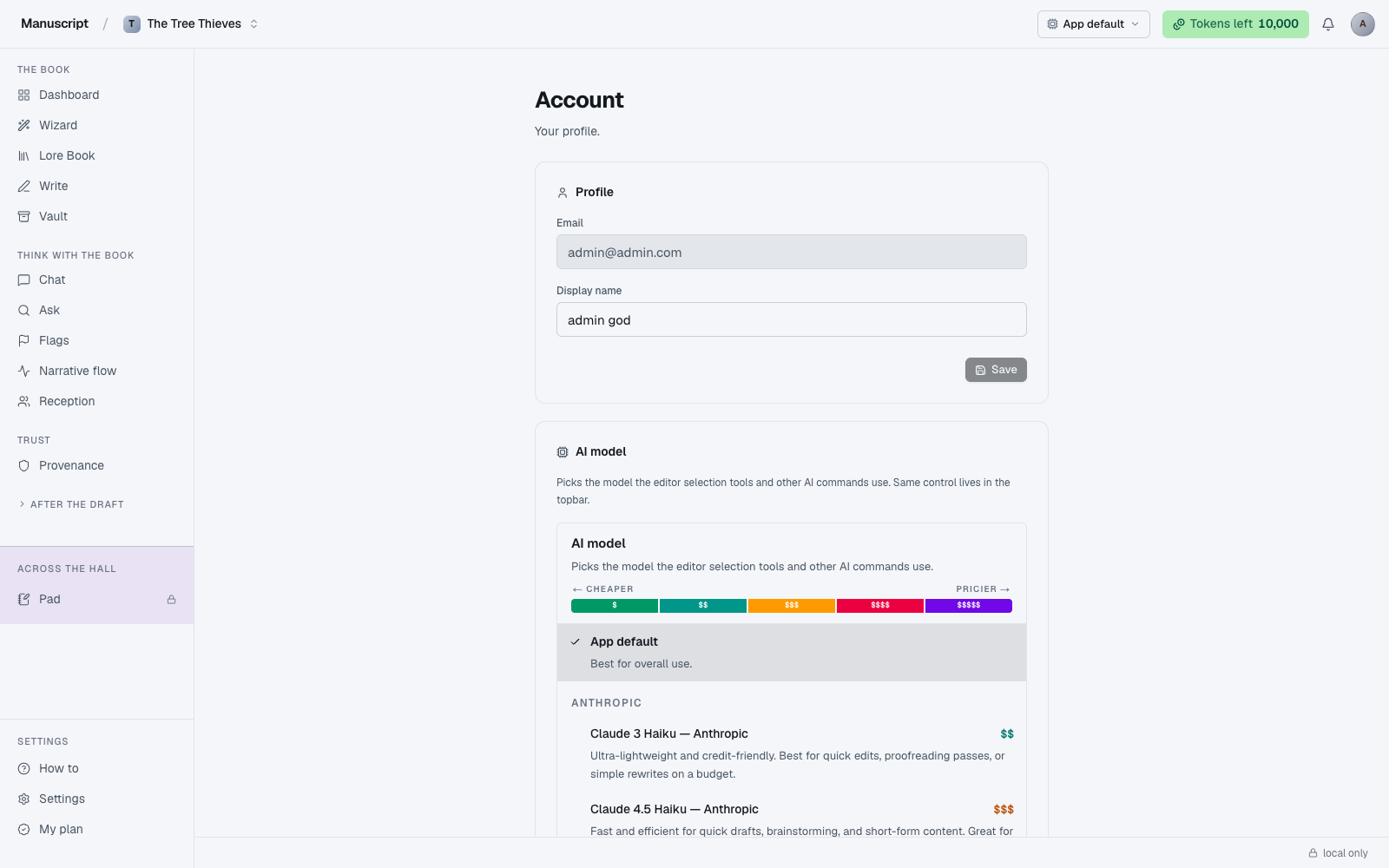
Which model runs my AI features
Every AI feature in Manuscripts.ai routes through OpenRouter — a neutral routing layer that reaches the underlying model providers (Anthropic, Google, OpenAI, Meta, DeepSeek, and others). OpenRouter is a passthrough: it takes our request, forwards it to the provider you (or the default) selected, and returns the response. It does not train on your prompts, and it does not modify the payload in transit.
The default model is chosen for a balance of quality and cost, and it changes over time as better options become available on the market. At the time of writing, most surfaces default to a Google Gemini model that costs roughly a quarter of the equivalent Anthropic or OpenAI model at similar quality for prose work. When we change the default, the change takes effect immediately for future runs — you don't need to update anything on your end.
You don't have to think about which model runs most of the time. Where it matters — on a surface where a heavier model would give meaningfully better output for the cost — the interface tells you what running it will cost against your weekly token budget before you click. See Tokens for how the budget accounting works.
If you want to lock in a specific model (because you've verified its training policy yourself, or because you know exactly which one produces prose you like), use the picker on the Settings page — the choice is per-account and applies immediately.
The 22-model catalogue
The picker offers 22 models across six providers. Some are cheap and fast; some are premium and slow. Each has a deduction multiplier: how many tokens come off your weekly budget per token the model actually generates. The full list lives in src/lib/models.ts and is surfaced on the Settings page with descriptions of what each is good at.
- Anthropic — Claude 3 Haiku (ultra-cheap,
deduction: 3), Claude 4.5 Haiku (deduction: 12), Claude 4.6 Sonnet (premium prose,deduction: 40) - OpenAI — GPT-4o mini (
deduction: 2), GPT-4.1 mini (deduction: 4), GPT-5 mini (deduction: 5), GPT-5.4 (top-tier,deduction: 75) - Google — Gemini 2.5 Flash (
deduction: 6), Gemini 3 Flash Preview (deduction: 6), Gemini 2.5 Pro (default for many surfaces,deduction: 25), Gemini 3.1 Pro Preview (deduction: 25) - DeepSeek — DeepSeek R1 Distill Llama-70B (
deduction: 1), DeepSeek R1 (deduction: 6) - Meta — Llama 4 Maverick (
deduction: 1), Llama 3.2 3B (deduction: 1) - Others — Qwen 3 235B, Kimi K2 Thinking, Mistral Nemo, Aion 2.0, Mancer Weaver (fiction-tuned), xAI Grok 4.3, Mistral Large 2407
Each model has a context window limit and a description on the Settings page — pick based on what you're doing. A long-form drafting session wants a large context window; a quick rewrite doesn't need one.
The deduction multiplier
Different models cost different amounts to run at the provider level. A single "token" from a lightweight model like Llama 3.2 3B doesn't cost the same as a token from a premium model like GPT-5.4 — the underlying compute is dramatically different. To keep your weekly budget fair across models (and to accurately reflect the real cost we're paying upstream), each model has a multiplier that translates raw model tokens into "budget tokens" deducted from your weekly quota.
Examples from the current catalogue:
- Llama 4 Maverick / Mistral Nemo / DeepSeek R1 Distill — deducts 1 budget token per raw token generated. As cheap as it gets.
- Claude 3 Haiku — deducts 3 per token. Very budget-friendly for editing and short rewrites.
- Gemini 2.5 Flash / DeepSeek R1 — deducts 6 per token. A middle-cheap tier that handles most tasks fine.
- Claude 4.5 Haiku / xAI Grok 4.3 — deducts 12 per token. Middle tier.
- Gemini 2.5 Pro / Gemini 3.1 Pro Preview — deducts 25 per token. Solid quality for long-form drafting.
- Claude 4.6 Sonnet — deducts 40 per token. Premium prose quality.
- GPT-5.4 — deducts 75 per token. Top-tier and priced accordingly.
Unknown models (any ID not in src/lib/models.ts) bill at DEFAULT_DEDUCTION = 200 — a safety-margin fallback that ensures we never accidentally undercount and give away free generations when someone forgets to register a new upstream. If you see that multiplier in your Tokens breakdown, tell support.
The Tokens page shows the effective deduction for every AI call you've made this week, grouped by task, so you can see where your budget went and which model contributed to which run.
Choosing a model
Most authors leave the default alone and get on with the writing. If you want to override it for a specific reason, the picker lives on the Settings page and takes effect immediately for future runs (in-flight runs finish on whatever model they started with).
Rules of thumb:
- Drafting prose you plan to accept — a middle-tier or premium model (Gemini 2.5 Pro or above; Claude 4.6 Sonnet for the crispest prose) is worth it. This is what shows up in your manuscript, and the deduction difference is small compared to the value of good drafting.
- Thinking out loud in Chat — a cheaper model (DeepSeek R1, Claude 3 Haiku, Gemini 2.5 Flash) is often enough. You're not writing prose, you're testing ideas.
- Templates and Desk drafts you'll edit heavily — middle-tier is usually fine. You're going to rewrite half of it anyway.
- Deep Analysis — the model is fixed for the simulation. You don't pick.
- Voice fingerprint generation — the model is fixed. It reads your prose and returns a strict JSON profile; a heavier model here is a one-time cost that improves every future run for as long as the profile stays on.
- Reports and Flags — the model is fixed per report so results are consistent across runs. You don't pick.
What if a model goes down
Model providers occasionally have outages — a bad deployment, a datacenter incident, a rate-limit trip. When that happens:
- OpenRouter usually falls back to a neighbouring model automatically (a Claude call may briefly route to a different Anthropic model, for example) and you won't notice the swap unless the fallback quality is visibly different.
- Your run may take longer than usual (extra hops), or you may see an error and have to retry manually.
- Nothing about your prose is lost — the retry works from the same prompt.
If everything is failing across multiple providers at once, our routing is probably the problem, not any one upstream. See Troubleshooting for the diagnostic pass — the short version is: try a different surface, try a different model, and if both fail, email support.
Free-tier restrictions
Some premium models are restricted on the Free plan even if you have tokens left. The deduction multiplier would burn a week of budget in a single premium run — running Claude Sonnet 4.6 at 40× or GPT-5.4 at 75× on the Free plan's smaller weekly quota would let you exhaust your budget in one long completion. Restricted-on-Free models are marked in the picker (allowFree: false in the underlying config), and if you pick one on Free, the interface tells you before you run and either offers a free-tier alternative or gates the run entirely.
Upgrading to Professional removes the free-tier gates. You still spend your token budget at the same rate; you just have the freedom to spend it on whichever model you want.
Privacy across models
Every model provider we route through has an API-mode agreement that they do not train on the prompts sent to them. This is contractually different from those companies' consumer chat products (ChatGPT, Claude.ai, Gemini.google.com), which may train on user chat by default. The API pathway we use does not.
If a specific model's training policy is a deal-breaker for you, pin that model in Settings and read its API terms directly — every provider publishes them. See Privacy for the wider privacy answer, including what we (Manuscripts.ai) do and don't store on our own end.
What we do not do
- We don't run our own foundation model. Every AI feature is an API call to a provider we vet.
- We don't cache your prompts across runs. Every run is fresh — no shared prompt cache that could leak between accounts.
- We don't share model choice across accounts. Your picker preference is per-account and doesn't influence anyone else's default.
- We don't fine-tune on your data. There's no per-user model that "learns you"; the voice fingerprint is a JSON profile injected into the system prompt, not a trained model. See Voice fingerprint.