For nonfiction and essay writing. Checks whether your argument moves cleanly from claim → evidence → conclusion without leaps the reader has to plug for you.
What it measures
The analyzer parses the argumentative structure of each paragraph in your manuscript and tries to classify it as an instance of the standard "claim → evidence → conclusion" chain (or the equivalent "premise → premise → conclusion" pattern used in more formal logical writing). It's looking for three moves in sequence: a claim being made, some form of evidence being cited or presented to support it (data, quotation, example, precedent, analogy, source citation), and a conclusion or synthesis drawn from the claim-plus-evidence pair.
Each paragraph resolves to one of three tiers. Complete (green) means the analyzer identified all three links — the chain reads as claim → evidence → conclusion in a way a reader can follow without gaps. Weak evidence (amber) means it found a claim and a conclusion but the evidence in between is thin — a single anecdote, an unattributed assertion, a citation without a quote, or an example so brief it doesn't carry the weight of the conclusion. Unsupported leap (red) means it found a claim and a conclusion but no evidence at all between them — the paragraph opens with a strong statement, does not support it, and jumps straight to a broader synthesis or generalization.
The card surfaces three stat tiles at the top — Paragraphs (total analyzed), Unsupported (count of red-tier paragraphs), and Weak (count of amber-tier paragraphs) — over a per-paragraph list. Each row in the list shows the paragraph's label (e.g. "§4.2" for the second paragraph of section 4), a one-word status (complete / weak evidence / unsupported), the detected chain shape as a hint (e.g. "claim → evidence → conclusion" or "claim → (thin) → conclusion" or "claim → conclusion"), and a colored tone pill.
The overall "shape" hint is diagnostic: "claim → conclusion" with nothing between the arrows is the classic unsupported leap; "claim → (thin) → conclusion" tells you the evidence exists but doesn't have enough weight; "claim → evidence → conclusion" is the clean chain the report is checking for.
Why it's useful
The most common flaw in nonfiction drafts is a paragraph that opens with a confident claim, cites a single anecdote or a passing reference, and jumps straight to a broader conclusion the evidence can't actually carry. The reader often doesn't notice the leap consciously — but they disengage. The argument feels less trustworthy without them being able to say why. This report surfaces the specific paragraphs where that pattern breaks, so you can either add evidence or soften the conclusion.
The typical scenario: you're revising a chapter of a nonfiction book and you have the vague sense that the middle section "isn't landing" but you can't pinpoint why. Run Argument flow. Three paragraphs in the middle section flag red for unsupported leaps; two more flag amber for weak evidence. Now you have a targeted revision worklist — the fix for each red is either adding a supporting example, quoting a source, or hedging the conclusion so it doesn't overreach the evidence.
For essayists this report is especially useful because essays live and die on the reader's trust in each move you make. A single unsupported leap in an essay can turn the reader from engaged to skeptical for the rest of the piece. Catching them at the paragraph level before the piece goes out is much cheaper than losing readers after publication.
Use this alongside Methodological compliance (which checks the outer structural beats of an academic piece rather than the internal argument shape) and Literature synthesis (which checks whether your citations are dense enough for the weight of your claims — a slightly different angle on the same problem). The three are complementary: Methodological compliance asks "does the whole piece have the standard shape?", Argument flow asks "does each paragraph make a valid move?", and Literature synthesis asks "is your evidence base wide enough?".
How to read it
The card opens with three stat tiles across the top: Paragraphs (blue, total analyzed), Unsupported (red, count of red-tier paragraphs — the ones with no evidence between claim and conclusion), and Weak (amber, count of paragraphs with thin evidence). These three numbers give you the top-line health of the argument: if Unsupported is 0 and Weak is small, the argument is structurally solid; if either number is large in absolute terms or as a fraction of total paragraphs, you have work to do.
Below the tiles is the per-paragraph metric list. Each row is anchored by the paragraph's label on the left (§4.2 style) with the status word ("complete", "weak evidence", "unsupported") as the value on the right and the detected chain shape as a hint below. A colored tone pill on the far right matches the tier — green for complete, amber for weak, red for unsupported.
The list is ordered by position in the manuscript, not by severity, so you read it top to bottom like reading the manuscript itself. Focus on the red rows first — those are the paragraphs where a reader would most notice the gap — and then work through the amber rows if you have time. Each fix is usually small: for a red row, add one sentence of evidence between the claim and the conclusion; for an amber row, upgrade the evidence to something more concrete (a quote instead of a paraphrase, a specific example instead of a vague reference).
The collapsed card summary in the reports rail shows an "ok" if there are no red rows and "missing" if any paragraph flagged as unsupported. Like the Methodological compliance card, this one uses coarse pass/fail summary rather than a numeric score because the fixes are binary — evidence is either there or it isn't.
When to ignore it
For narrative fiction, this report is going to flag most of your prose as "not an argument" because narrative paragraphs aren't structured as claim-evidence-conclusion chains and shouldn't be. Turn it off in the panel toggles. The report has no way to distinguish fictional narration from a structural argument, and the noise is unhelpful.
Descriptive prose (setting descriptions, scene-setting, atmospheric writing) in nonfiction also isn't argumentative and will flag as "unsupported" even when it's doing exactly what it should. If a paragraph's job is to paint a scene rather than to argue a point, the "claim → conclusion" pattern doesn't apply. Read past those flags.
Highly stylized argument writing — think Emerson, Nietzsche, aphoristic essays — often makes deliberately unsupported claims because the aphoristic form is the point. The whole rhetorical mode is "make the assertion sharply enough that the reader supplies the evidence themselves." This report will flag every aphorism as an unsupported leap, and it's not wrong on the structural level — but the flag isn't actionable if the leap is your voice.
Legal writing, formal proofs, and formulaic argument structures where the evidence is understood to live elsewhere (a case brief that assumes the underlying opinion is known, a mathematical proof that assumes prior theorems) will also produce false positives — the evidence is real but not on the page in the form the analyzer expects. Judgment applies.
How to run it
- Click Write in the left sidebar and open the document you want to analyze.
- Open the right-side rail: click the Reports button in the editor's top toolbar (the bar-chart icon).
- In the rail header, click the Reports tab.
- Scroll to the Argument flow card under the Academic heading.
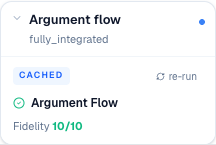
- Click the card to expand it. First-time runs take 5–20 seconds; a spinner in the header shows while the LLM streams. Cached results render instantly. Use re-run after revising the argument scaffolding.
- The card renders three stat tiles — Paragraphs, Unsupported, Weak — over a per-paragraph list. Each row shows the paragraph label (e.g. §4.2), a status word (complete / weak evidence / unsupported), the detected chain shape (e.g. "claim → evidence → conclusion"), and a green / amber / red tone pill.
What to read next
- Methodological compliance — the sister report for academic structure
- Reports — back to the panel overview