Identifies the biggest themes in your manuscript automatically — the underlying ideas your prose keeps returning to. Useful for spotting what your book is actually about, not just what you think it's about.
What it measures
The analyzer runs an LDA-style topic model over your paragraphs — Latent Dirichlet Allocation, a classical statistical approach that groups documents (in this case, paragraphs) into clusters based on which words tend to co-occur. Each cluster represents a latent theme that runs through some portion of the manuscript, and each theme gets labeled with the words that most distinctively describe it (the "semantic cluster" data returned to the client).
The output is a ranked list of concepts: for each theme, a short label (the most distinctive words concatenated or interpreted into a plain-English phrase like "grief and inheritance" or "silence between siblings"), a strength percentage indicating what share of the manuscript is thematically anchored to that cluster, and a latent thematic density number in the deeper data — a measure between 0.0 and 1.0 of how tightly the themes cluster overall. Higher density means the manuscript is thematically focused; lower density means the themes are more diffuse.
The strength percentages don't sum to 100% because paragraphs can participate in multiple themes and some paragraphs don't strongly participate in any detected theme. A dominant theme at 34% means a third of your prose is anchored in that idea cluster; a long-tail theme at 9% means a smaller but still-recurring thread. Typically a well-focused book will have one theme in the 25–40% range, two or three in the 10–20% range, and a scatter of smaller themes below.
Because it's a statistical topic model rather than a semantic-understanding pass, the themes it detects are word-frequency-driven — a theme is a cluster of words that keep appearing together, and the label is derived from those words. That means the analyzer is picking up what you're literally writing about at the vocabulary level, not what you might describe your book as being "about" in a marketing sense. Those two are frequently different — sometimes revealingly so.
Why it's useful
Every author has a theme they think the book is about and a theme the book is actually about at the level of what the sentences keep circling. Sometimes those match. Often they don't. This report tells you what your prose is doing beneath the plot — the tacit throughlines that emerge from what you kept typing about, whether or not you meant to.
The typical scenario: you set out to write a novel about ambition, but the top theme comes back as "grief and inheritance". That's not the report making a mistake — it's the report telling you that at the word-frequency level, grief and inheritance are what your prose keeps returning to, and ambition may be your intended subject while grief is your actual subject. Either you have a subtext you didn't know about (worth leaning into on the next revision), or you have a subtext you did intend but under-invested in and the intended theme isn't landing (worth adding scenes that carry the intended theme more explicitly).
For nonfiction and essay work the same principle applies — the recurring vocabulary is often more diagnostic of your actual argument than the summary you'd give of it. A book you'd describe as "about climate policy" might come back with themes dominated by "adaptation and coastal displacement", which tells you where the book's center of gravity actually sits.
Use this alongside Semantic arc (which tracks how themes shift across the book — a healthy arc usually has themes that evolve rather than staying flat) and Voice fingerprint (which captures your stylistic tell rather than your thematic content). The three together give you the "what am I writing about, how does it evolve, and how do I sound while doing it" triad.
How to read it
The card opens with a Top concepts section labeled in ink. Below the label is a metric list — one row per detected theme, capped at the top 8. Each row has a theme word or short phrase on the left, a horizontal fill bar in the middle (colored on a rotating palette of purple / blue / cyan / pink so the themes visually separate), and the numeric strength count on the right (e.g. "34"). The bar length is scaled to the strongest theme, so the top row's bar fills the whole width and the smaller themes fill proportionally less.
Below the list is a one-line Latent density value — printed to four decimal places (e.g. "0.0284") in bold ink type. Low density (under 0.05) means the themes are diffuse — your prose covers a wide range of ideas without settling; high density (above 0.15) means the themes cluster tightly — your prose keeps returning to a small set of recurring ideas. Neither is inherently better; different genres and different books legitimately sit at different densities.
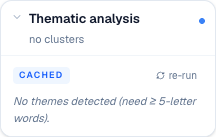
The collapsed card summary in the reports rail shows the top three theme labels comma-separated ("themes: grief, silence, inheritance") so you can see the thematic signal at a glance from the panel without expanding. When you dig into the ranking, the interesting reads are the surprises — a theme you didn't expect in the top 3, or a theme you thought was dominant showing up at #7. Both are usually worth investigating.
If the top theme surprises you, that's the report doing its job — either you have a subtext you didn't know about (which you can lean into on the next revision) or you have a subtext you did intend but haven't given enough on-page space to, which the low ranking is quietly telling you.
When to ignore it
Very short manuscripts and manuscripts on a very narrow topic will produce a couple of dominant themes and nothing else — that's expected because there simply isn't enough vocabulary variety for the topic model to distinguish multiple clusters. Below about 5,000 words the report is basically not statistically meaningful. The interesting output is on book-length prose with multiple threads.
Genre fiction that leans on a fixed vocabulary of settings, plot mechanics, or props (military thrillers, hard sci-fi, procedurals) will produce themes dominated by that domain vocabulary — a military thriller might come back with themes like "weapons and tactical positions" that describe the surface layer of the plot rather than the underlying meaning. That's not wrong, just less interesting than the same report run on a book with more thematic range. Adjust expectations for the genre.
Books with lots of proper nouns (fantasy with invented place names, sci-fi with technical terminology, historical fiction with period-specific vocabulary) can produce themes that are essentially "the vocabulary of this fictional world" rather than "the ideas of this book" — again, not wrong, but the report is more useful for realist fiction where the vocabulary is drawn from ordinary language and the recurring words are actually thematic.
And any manuscript in a language other than English will produce weak or nonsensical themes — the topic model is tuned for English word statistics and doesn't transfer cleanly to other languages without retraining.
How to run it
- Click Write in the left sidebar and open the document you want to analyze.
- Open the right-side rail: click the Reports button in the editor's top toolbar (the bar-chart icon).
- In the rail header, click the Reports tab.
- Scroll to the Thematic analysis card under the Academic heading.
- Click the card to expand it. First-time runs take 5–20 seconds; a spinner in the header shows while the LLM streams. Cached results render instantly. Use re-run after any large-scale revision.
- The card renders a Detected themes section: each theme gets a plain-English label (e.g. "grief and inheritance"), a strength percentage, and an animated horizontal bar sized to that percentage. The collapsed summary lists the top three theme labels.
What to read next
- Semantic arc — how themes shift across the book
- Reports — back to the panel overview