Tracks how the themes shift across the book. A well-structured story usually has themes that evolve — not stay flat or jump around at random.
What it measures
The analyzer takes each chapter of your manuscript, computes a semantic embedding for it (a high-dimensional vector representing the meanings, motifs, and topical center of gravity of that chapter), and then plots the sequence of those embeddings as a trajectory through semantic space. The output is a curve — the theme arc — with one point per chapter, showing how much the chapter's meaning has shifted from the last.
The symbolic cohesion score is the summary number: a 0–1 value that quantifies how well the chapters' semantic content holds together as a single coherent progression. High cohesion (near 1) means the arc feels like a single story unfolding with recognizable through-lines. Low cohesion means the chapters read as independent episodes with no connecting semantic tissue.
Under the hood the analyzer is looking at three shapes: direction (are chapters trending toward a different region of semantic space, or are they orbiting the same territory?), smoothness (do adjacent chapters share meaningful semantic overlap, or do they jump-cut?), and spread (does the total semantic territory covered feel like the scope of a novel, or is it either too narrow or too diffuse?).
A caveat: the analyzer sees words, not story. If your novel is about grief but your prose talks about weather, the semantic embedding measures the weather. Books with heavy subtext, deliberate obfuscation, or highly figurative language can produce arcs that don't match the plot's structural arc. Read the curve as a description of what your prose is topically doing on the surface, not as an oracle about theme.
Why it's useful
Books with strong structural progression have a smooth semantic arc: early chapters cluster near one region of meaning-space, middle chapters shift as complications enter, late chapters land somewhere different from where the book started. Even when a story returns to its starting location or characters, the meaning has changed — and the semantic arc shows that transformation.
Books with structural problems produce two failure modes visible in the curve. Flat-line arcs — the shape barely moves — mean the book is stuck in one register. The characters may be doing things, but topically the prose is chewing on the same handful of concerns from Chapter 1 to Chapter 40. Readers describe this as "nothing happens" or "the book runs out of steam." Jump-cut arcs — random spikes with no through-line — mean the chapters read as independent episodes. Readers describe this as "it lost me" or "I couldn't see what it was about."
The natural companion is Pacing arc, which measures how tension rises and falls independent of what the prose is about. Together they tell you two things you can't feel from inside the draft: is the emotional pressure building (pacing arc), and is the thematic territory evolving underneath it (semantic arc). A great book usually shows both curves rising in tandem toward the climax.
How to read it
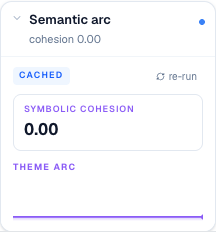
The collapsed card headline reads cohesion … — the symbolic-cohesion score at a glance. Expand the card and you see two blocks stacked vertically.
The top block is a compact MiniStat tile: label "symbolic cohesion" in small caps, the number below it in bold purple. Higher is better; treat above 0.7 as strong, 0.5–0.7 as reasonable, below 0.5 as concerning.
Below that is the Theme arc section — a purple sparkline showing the semantic trajectory across the manuscript from left (opening) to right (ending). Read the shape, not the exact values. A smooth upward slope means the meaning is drifting cleanly from the opening toward a different destination. A gentle S-curve means the book pivots around its midpoint (classic three-act shape). A flat line means the semantic territory isn't moving. Sharp spikes mean adjacent chapters have very little in common.
There are no per-chapter click-throughs in this card. The sparkline is descriptive — its purpose is to let you see the shape of your book's semantic progression, not to jump you to a specific chapter. To investigate a suspicious spike or trough, count roughly how far through the book that point sits and open the corresponding chapter in the editor.
The card header carries a small colored dot next to the label — green for "fresh" (this run just computed), blue for "cached" (server's most recent computation still valid). Inside the expanded card, a "fresh" / "cached" pill sits above the sparkline with a re-run button next to it to force a fresh compute after a major revision.
When to ignore it
Anthologies and short-story collections are supposed to jump-cut. Each story is a fresh semantic starting point, and the collection's coherence lives at a level the analyzer can't see — thematic resonance across pieces, tonal continuity, the editor's arrangement. This report will flag a jagged arc that is entirely correct for the form. If you're editing a collection, ignore the curve.
Multi-POV novels produce more variance than single-POV ones — each POV has its own vocabulary, concerns, and world. That's not disorder, that's structure. Expect a lower cohesion score for something like A Song of Ice and Fire than for The Remains of the Day. Compare against your form before treating the number as prescriptive.
Novels that revisit the same location or character across chapters (a haunted-house novel, a chamber piece, a locked-room mystery) will produce a flat-line arc that is faithful to the book — the book's meaning genuinely orbits one place. That's fine when it's the intent. Only worry about a flat line when you expected movement.
Finally, the score is unreliable on books under about 15,000 words — you don't have enough chapters to plot a meaningful trajectory. Wait until you have at least 5–6 substantial chapters before reading this metric as anything but a rough gauge.
How to run it
- Click Write in the left sidebar and open the document you want to analyze.
- Open the right rail: click the Reports button (bar-chart icon) in the editor's top toolbar.
- In the rail header, click the Reports tab.
- Scroll to the Semantic arc card under the "Linguistic" heading.
- Click the card to expand. First-time runs take 5–20 seconds (this is one of the slower reports because it embeds every chapter). Cached runs render instantly.
- The row headlines with
cohesion …— the symbolic-cohesion score. Expand to see the trajectory curve chapter by chapter.
What to read next
- Thematic analysis — what those themes actually are
- Pacing arc — the tension curve counterpart
- Reports — back to the panel overview