Scores how well you tied off the plot threads you opened, and flags chapters where the pacing speeds up or stalls too suddenly.
What it measures
Two independent things that both roll into a single story score on a 0–100 scale.
First, a thread resolution matrix. The analyzer walks your manuscript and detects setups — moments where the text opens a question ("what's in the drawer?"), makes a promise ("I'll come back for you"), or introduces a mystery (an unexplained object, a foreshadowed danger, an unresolved conflict). For each detected thread it then walks forward and checks whether the manuscript pays it off before the end. Each thread gets a resolution strength from 0.0 to 1.0: 0.6+ counts as resolved, 0.2–0.6 as partial, below 0.2 as open. The list of unresolved threads is surfaced separately so you can see exactly which promises the analyzer thinks you haven't kept.
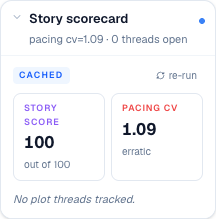
Second, a pacing coefficient of variation (labeled "pacing cv" in the UI). The analyzer estimates chapter-level tension using the same signals as Pacing arc — action density, dialogue-to-narration ratio, sentence length, stakes markers — then computes how much the tension varies chapter-to-chapter. Under 0.3 reads as "even" (steady rise), 0.3–0.5 as "varied" (healthy peaks and valleys), above 0.5 as "erratic" (sudden lurches). Chapters where the tension jumps or drops by more than a threshold get called out as pace shifts with a direction: "sudden acceleration" or "sudden stall".
Together the two axes give you a single-panel view of structural health: are the promises being kept, and does the rhythm feel deliberate?
Why it's useful
Every book leaves a few threads open — that's fine, sometimes even desirable. But an unpaid promise that a reader spent a lot of setup on will land as a broken contract, and it's usually invisible from inside a draft because you know what you meant to happen. The scorecard tells you which threads the analyzer thinks are still open, so you can decide whether each one is a deliberate mystery, a sequel hook, or a genuine oversight to fix.
Similarly, a sudden pace stall in the middle third is the most common structural weakness of first drafts — the classic "middle-book sag" — and it's hard to feel at book length. You know something's off in chapter 8 but you can't quite say what. The scorecard names it: "Ch 8 · sudden stall". The chapter after a big set piece is a frequent offender; so is any chapter where you paused the plot to do a lot of character work.
Use this report as a companion to Pacing arc (which gives you the full-book tension curve) and Plot holes (which catches fact-level continuity errors rather than promise-level ones). Story scorecard is the highest-altitude structural report — you'd read it before making a revision plan, and check it again after each pass to see whether your changes closed the gaps you were targeting.
How to read it
The card opens with two stat tiles at the top: story score (0–100, purple) and pacing cv (a decimal like 0.24, colored green under 0.3, amber under 0.5, red above 0.5, with a hint word — "even" / "varied" / "erratic"). These are the two headline numbers.
Below is a Thread resolution section. It renders as a metric list — each row shows the thread's short ID (usually a compact label the analyzer derived from the setup, like "owens-disappearance" or "locked-drawer"), the resolution strength as a percentage (e.g. "82%"), and a colored fill bar behind the percentage. Green fills mean the thread landed cleanly; amber means partial; red means open. The list is capped at the top 8 threads by importance.
Under that is an Unresolved chip list — a compact display of every thread with resolution under 20%. These are the ones the analyzer is most confident you didn't close. If there's nothing here, the section is hidden entirely.
For the pacing side, the collapsed card summary shows a headline like "pacing cv=0.34 · 4 threads open" so you can read the state without expanding. Each pace shift gets called out as its own row in the shifts list with the chapter number, the direction of the shift (acceleration or stall), and a tone pill matching the severity — stalls in the middle third get flagged red because that's where they hurt most.
Read the list the same way you'd read a beta reader's notes: not as a checklist to zero out, but as a set of prompts. Each unresolved thread is a "did you mean to leave this open?" question. Each pace shift is a "is this jump deliberate?" question. Answer them one at a time.
When to ignore it
Threads you're deliberately holding for a sequel or a series arc will always show as "open" — that's expected and there's no way to tell the analyzer "this one's on purpose." Same with any deliberate ambiguity: if the whole point of your ending is that some questions aren't answered, the report will flag every one of those questions. Read the unresolved list, mentally mark the intentional ones, and act on the rest.
Pace shifts you engineered on purpose — a sudden quiet after a chase scene, a hard cliffhanger cut, a deliberate reset chapter after a big reveal — will also flag. The report is describing the shape of your book, not judging whether the shape is right. A "sudden stall" in chapter 8 could be a problem to fix or it could be exactly the beat of quiet you wanted; only you know which.
Very short manuscripts (under about 15,000 words) or novellas won't have enough chapters for the pacing coefficient to be meaningful — you need at least six or seven chapters before variation is even measurable. And nonfiction, essays, and collections of shorter pieces don't have "threads" in the sense the analyzer is looking for, so both halves of the scorecard tend to be low-signal for those. For nonfiction structural work, Argument flow is the better tool.
How to run it
- Click Write in the left sidebar and open the document you want to analyze.
- Open the right-side rail: click the Reports button in the editor's top toolbar (the bar-chart icon).
- In the rail header, click the Reports tab.
- Scroll to the Story scorecard card under the Structural heading.
- Click the card to expand it. First-time runs take 5–20 seconds; a spinner in the header shows while the LLM streams. Cached results render instantly. Use re-run inside the expanded card to recompute.
- The card renders two stat tiles — Threads closed (e.g. "3 / 4") and Pace shifts — over two sub-lists: Threads shows each detected setup with a colored status pill (green resolved / amber partial / red open), and Pace shifts lists the chapters where pacing accelerates or stalls.
What to read next
- Pacing arc — the full-book tension curve
- Reports — back to the panel overview