Measures how surprising your sentence-by-sentence prose is. Too predictable reads as flat; too unpredictable reads as confused. There's a sweet spot.
What it measures
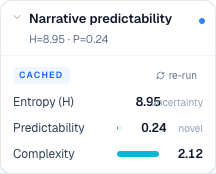
The analyzer computes three related numbers over the whole manuscript. Entropy (H) is how much information the model needs to encode your next word given the previous ones — high entropy means each new word carries a lot of new information (unpredictable, novel), low entropy means each new word is largely inferable (predictable, conventional). Predictability (P) is a normalized 0–1 score derived from H — above 0.5 reads as predictable, below reads as novel. Complexity is a companion index that tracks structural (not just lexical) variety in your sentences.
Entropy is bounded roughly 0–12 in practice for English prose. Predictability sits in the 0.35–0.65 band for most published fiction. The values are computed at the sentence level and then averaged; a book with a smooth mix of familiar and surprising phrasings tends to land near P ≈ 0.5 with H ≈ 6–8.
A caveat on the methodology: perplexity is a statistical measure of surprise, not an aesthetic one. It cannot distinguish between "surprising because the imagery is fresh" and "surprising because the syntax is broken." Very high entropy scores often flag deliberately fractured or lyrical prose the same way they flag a typo storm. Read the flag as a pointer, then look with your own eyes.
Why it's useful
Prose that's too predictable reads as clichéd — readers finish your sentences in their heads before you do, and boredom sets in three chapters before they close the book. Prose that's too unpredictable reads as chaotic or affected — readers feel like they're missing context and stop trusting the narrator. Somewhere in the middle is where the prose feels inevitable: surprising but right, so that the reader is pulled forward without ever losing footing.
This report exists because the "predictability problem" is nearly invisible when you're the writer. You know what comes next, so nothing surprises you when you re-read. A per-chapter H/P curve tells you where the reader is going to feel bored (P dropping toward 0.7+) or bewildered (P spiking toward 0.2) — places you literally cannot feel from inside the draft.
Use it alongside Stylometry (which measures vocabulary richness) and Sentence analysis (which flags the specific sentences at the extremes). Predictability tells you where the prose flattens; Sentence analysis tells you which sentence is doing the flattening.
How to read it
The collapsed card headline reads H=… · P=… — a two-number summary at a glance. Below it, when you expand the card, are three horizontal Row bars stacked in the panel: Entropy (H) with a purple fill (labelled "uncertainty"), Predictability with a green fill when the value is below 0.5 ("novel") or an amber fill when above ("predictable"), and Complexity with a cyan fill.
Each row shows the numeric value on the right (mono, tabular). The color of the bar itself carries the verdict — green means the number is in the healthy band, amber means it's drifted toward one edge, red means it's pushed hard into the danger zone. On the Predictability row specifically, the green/amber flip at 0.5 is the load-bearing signal: green below 0.5 (novel prose), amber above 0.5 (predictable prose).
There are no per-chapter click-throughs in this card — Predictability is a whole-manuscript diagnostic, not a per-passage flag list. To find the specific sentences at the extremes of your predictability curve, cross-reference against the heaviest paragraphs in the pinned Sentence analysis card at the top of the panel.
The card header carries a small colored dot next to the label: green for "fresh" (this run just computed from your current manuscript), blue for "cached" (this is the server's most recent computation and it hasn't been invalidated). A re-run button appears next to the "fresh"/"cached" pill inside the expanded card to force a fresh compute.
When to ignore it
Genre conventions matter a lot here. Thriller prose is supposed to be more predictable — it's driving forward, not lingering, and every sentence exists to move the plot one clean beat further. Romance and cozy mystery follow tight structural conventions the reader wants recognisable. If your target genre is one of those, a P score of 0.55–0.65 is a feature, not a bug.
Conversely, literary fiction, prose-poetry, and experimental writing are supposed to sit lower — surprise is part of the aesthetic contract. Nabokov, McCarthy, Woolf, and their descendants would all score below 0.4 and be right to do so. If you're writing in that tradition, don't panic when the amber "novel" band fills.
The score is also unreliable on very short passages — the confidence interval widens dramatically below a few thousand words, so early drafts of new chapters may swing wildly between runs. Wait until a chapter is roughly complete before reading its Predictability score as anything but a rough gauge.
Finally, dialogue-heavy passages compress toward predictability naturally (character speech follows tighter conventions than narration). A dialogue-heavy chapter will pull the number up without saying anything about the quality of the writing.
How to run it
- Click Write in the left sidebar and open the document you want to analyze.
- Open the right rail: click the Reports button (bar-chart icon) in the editor's top toolbar.
- In the rail header, click the Reports tab.
- Scroll to the Narrative predictability card under the "Narratology" heading.
- Click the card to expand. First-time runs take 5–20 seconds (spinner in the header while streaming). Cached runs render instantly, and a "cached" pill appears next to the re-run button.
- The card renders with a headline entropy/predictability summary (
H=… · P=…) and the per-chapter curve inside. Use the re-run button at the top of the expanded card to force a fresh compute after major edits.
What to read next
- Sentence analysis — for the specific sentences at the extremes
- Reports — back to the panel overview