For research-heavy nonfiction. Maps which sources you cite, how often, and where citations are thin.
What it measures
The analyzer parses citation patterns across your manuscript — bracketed references ([Kaplan, 2019]), footnote markers, parenthetical author-year citations ((Chen, 2018)), narrative citations ("as Owens and Reyes (2021) argue"), and any consistent bibliographic markup you're using. It builds a source frequency map (which references you cite, and how many times each), computes an overall citation density measure (roughly citations per 1,000 words or per paragraph, normalized to be comparable across manuscript sizes), and produces a gap analysis — a short LLM-generated summary of where the analyzer thinks your citations are thinnest given the weight of the surrounding claims.
Citation density is typically expressed as a small decimal — 0.5 means roughly one citation every two paragraphs on average; 2.0 means several citations per paragraph. What counts as "adequate" depends heavily on the genre: a peer-reviewed article usually sits at 1.5–3.0; a trade nonfiction book at 0.3–1.0; a survey article at 3.0+. The report doesn't score you against a target — it just gives you the number, which you interpret in the context of what you're writing.
The sources list is the deduplicated set of references the analyzer detected, capped for display at the top-cited entries. A source like "Kaplan 2019" that appears 14 times across the manuscript is likely a foundational reference; a source that appears once might be a passing citation or a signal that the reference is being under-used relative to how central it is to your argument.
The gap analysis is a plain-English observation about the citation pattern — usually a sentence or two identifying either sections that are conspicuously under-cited (making strong claims without pointing at sources) or an overall imbalance (too many citations to a single author, or a section of the argument that relies on unpublished/unnamed sources).
Why it's useful
Under-cited sections are the most common substantive weakness in a research draft. A reviewer or a peer reader can tell within a few paragraphs whether your evidence base is present — and specifically whether it's cited on the page or just implied to exist somewhere in your notes. This report gives you a bird's-eye view of both dimensions: which sources you actually lean on, and where the citation coverage drops off relative to the claims being made.
The typical scenario: you're finalizing a research chapter and want to check whether the argument is properly supported throughout. Run Literature synthesis. The density number comes back at 0.9, which is roughly what you'd expect for a trade nonfiction book; the sources list shows five references dominate ("Kaplan 2019" at ×14, "Owens & Reyes 2021" at ×9, and so on down); the gap analysis flags one specific chapter section where the claims are dense but the citation count drops. Now you have a targeted revision — go to that section, add three or four citations that support the specific claims being made, and re-run.
For dissertation and thesis writers this report doubles as a coverage check across the literature review — if your top-cited authors don't match the field's central authors, that's a signal you might have blind spots in your reading. Similarly, if one author dominates your citation list by a wide margin, that's a signal your framing might be over-anchored on a single perspective.
Use this alongside Argument flow (which checks whether each paragraph internally moves from claim to evidence to conclusion — a paragraph-level check that pairs naturally with the manuscript-level citation-density check) and Methodological compliance (which checks whether your outer structural beats are present). The three cover the "structure, argument shape, evidence base" triad of academic writing checks.
How to read it
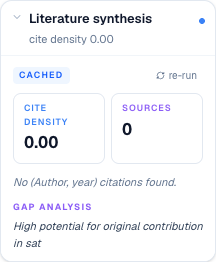
The card opens with two stat tiles: cite density (a decimal like "0.94" in blue) and sources (the count of unique references detected, in purple). These two numbers give you the top-line evidence footprint at a glance.
Below the tiles is a Cited section — a chip list of the sources the analyzer detected, capped at the top 12 in blue chips. Each chip is a short reference label (author-year style like "Kaplan 2019", "Chen 2018") that you can scan quickly to see who you're actually leaning on. If the section is empty ("No (Author, year) citations found."), the analyzer didn't detect a formal citation pattern in your manuscript — usually because you're using an inline style the parser doesn't recognize, or because the manuscript really has no formal citations.
Below the chips, when present, is a Gap analysis section labeled in purple with a short italic sentence or two summarizing where the citation coverage is thin. This is the actionable part of the report — the density number tells you the overall shape, but the gap analysis names the specific weakness so you know where to focus.
The collapsed card summary in the reports rail shows the citation density printed to two decimals ("cite density 0.94") so you can see the evidence footprint at a glance from the panel without expanding. When the density is well below what your genre expects, expand the card and read the gap analysis — that's usually where the actionable observation is.
For thin sections identified by the gap analysis, the fix is almost always mechanical: identify the specific claims in that section that aren't supported and add citations that ground them. If the same source dominates the cited list far more than the others, consider whether you can add citations that either corroborate or challenge that source — over-reliance on a single voice can weaken the argument even when the source itself is solid.
When to ignore it
For any manuscript that isn't citation-based — fiction, poetry, narrative nonfiction without formal refs, memoir, personal essays — this report will just be empty. That's fine and expected. Turn it off in the panel toggles so it doesn't sit at the top of your Academic category as a permanent zero.
Even within nonfiction, some legitimate forms don't use formal citations. Long-form journalism cites through named-source attribution ("Ada told me over coffee...") rather than parenthetical references. Trade nonfiction often uses a chapter-end notes format that lives outside the paragraph flow and won't be caught by the inline parser. Personal essays and criticism sometimes cite by quotation-and-attribution ("as Sontag put it...") without formal reference. In all these cases the report will show a very low density number that doesn't mean your evidence base is thin — it means the parser can't see it.
Endnotes-only citation styles (where the entire references live in a Chicago-style endnotes section rather than inline) will produce a low or zero citation density because the analyzer is looking at the paragraph text, not the notes section. This isn't a bug — it's a limitation of what "citation density" can mean when the citations aren't on the page.
And any manuscript still in early draft where you've been using placeholder citations ("[cite]" or "[XX]") that don't follow a real format will produce meaningless output. Convert your placeholders to real citations before treating this report as diagnostic; before that, the density number is measuring what you haven't written yet.
How to run it
- Click Write in the left sidebar and open the document you want to analyze.
- Open the right-side rail: click the Reports button in the editor's top toolbar (the bar-chart icon).
- In the rail header, click the Reports tab.
- Scroll to the Literature synthesis card under the Academic heading.
- Click the card to expand it. First-time runs take 5–20 seconds; a spinner in the header shows while the LLM streams. Cached results render instantly. Use re-run after adding or removing citations.
- The card renders three stat tiles — Sources, Citations, Thin sections — over a Most cited list. Each row shows a source label (e.g. "Kaplan 2019") and a citation count (e.g. ×14). The collapsed summary shows citation density.
What to read next
- Methodological compliance — for the structural checklist
- Argument flow — for the claim-evidence-conclusion shape
- Reports — back to the panel overview